
Prediction Markets Grow Up
From Legal Battles to Liquidity Wars: The Evolution of Prediction Platforms
Taylor Swift may be the most popular artist in America but globally the top spot this year goes to Bad Bunny. With more than 19.8 billion streams, he is Spotify’s most-played artist of 2025, ahead of Taylor, The Weeknd, Drake and Billie Eilish. His album, Debí Tirar Más Fotos, was also the year’s biggest – paving the way for him to perform at next year’s Super Bowl.
For a bettor who goes by the name Domer on the internet, this was good news. Earlier this year, he bet just over $100,000 that Bad Bunny would reign supreme and, with the release of the Spotify rankings this week, he booked a profit of $96,000. A side bet that Taylor Swift wouldn’t be the top Spotify artist of 2025 netted him a further $6,000. Several smaller, lower conviction bets lost him money but, overall, Domer cleared $87,000 wagering on people’s Spotify streaming habits.
Domer doesn’t just bet on music. He’s interested in politics and economics and culture. As one of the biggest users of prediction platform Polymarket, he’s placed over $420 million of bets since becoming a customer in 2022. One of his biggest wins was on JD Vance being nominated as Donald Trump’s running mate in 2024. His insight that Trump would choose a candidate with a monosyllabic surname persuaded him to put close to $120,000 down on an outcome initially priced as a 2% longshot.1 Elsewhere, he correctly predicted that the Federal Reserve would cut rates by half a percentage point in September 2024 – a trade which earned him $150,000.
Since registering with Polymarket, Domer has made $2.4 million in profit. “I don’t think of myself as a gambler,” he told CBS News’ 60 Minutes this week. “I’m taking very, very well-researched views on things. I feel like it’s much more akin to investing.” Current exposures span Time magazine’s person of the year (he doesn’t think it will be the Pope), the next Federal Reserve chair (no announcement until next year), and box office receipts on the new Avatar movie (not as big as Wicked).
Domer is one of a growing band of people using prediction markets to express views across a range of events. Polymarket, founded in 2020, now has around 500,000 monthly active users, though until recently it was banned in the US. Rival service Kalshi, which has been operational in the US since 2021, counts more than 4 million retail participants. Between them, notional trading volumes have grown from $500 million per week at the beginning of the year to over $2 billion today. Weekly volumes now routinely exceed the peaks reached during last year’s US election.
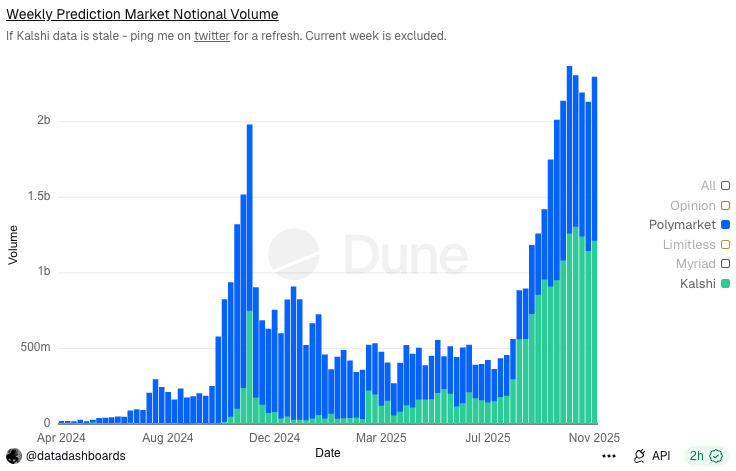
Kalshi co-founder, Tarek Mansour, is bullish. He thinks prediction markets could become as big as stock markets. “When we first started the company, this idea of a financial market that prices questions about the future, we were very drawn to it because if you could build such a financial market, it could be the largest of them all because the largest number of people will care.”
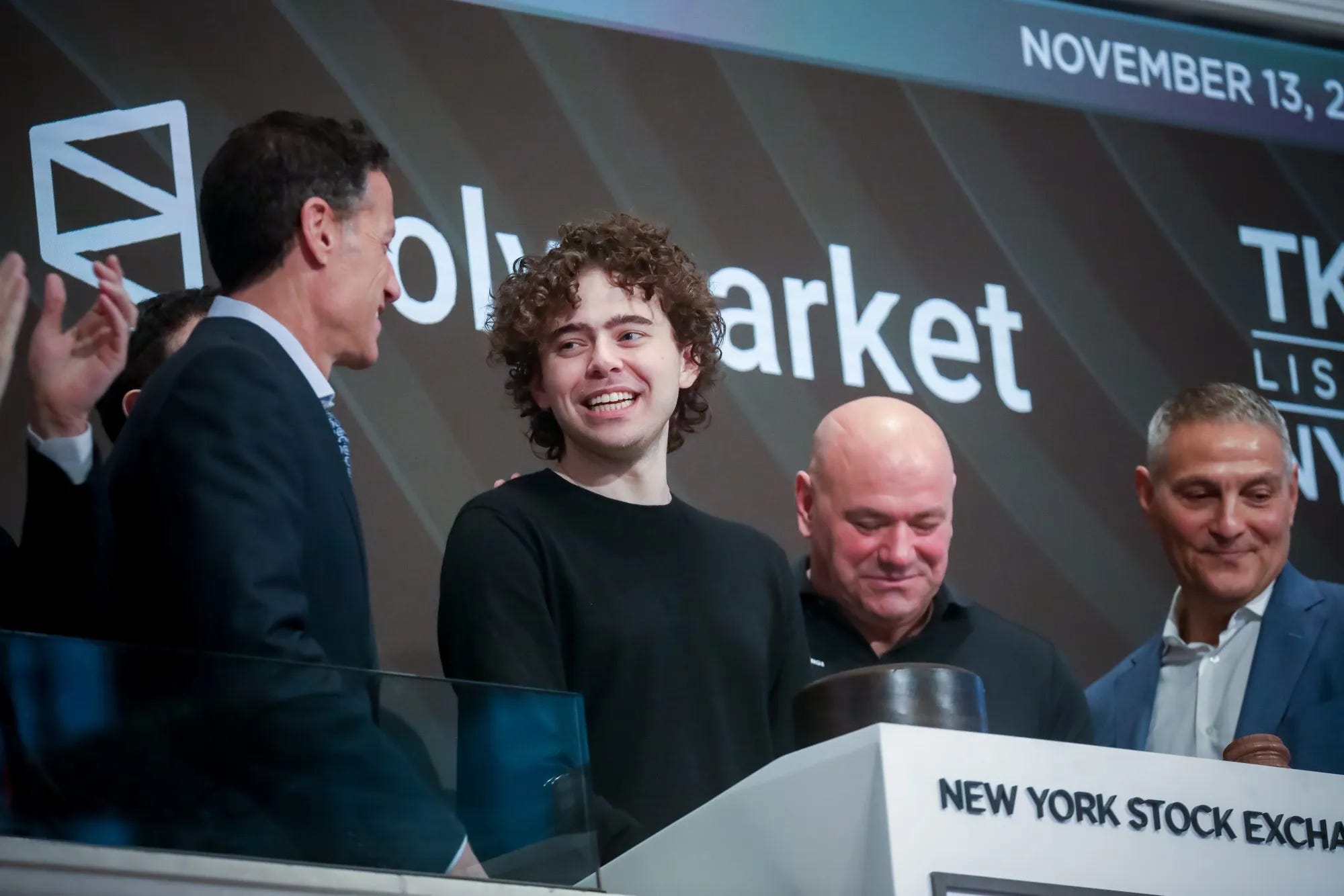
Investors are backing him. This week, Kalshi raised $1 billion in new funding at an $11 billion valuation, twice the value it secured just two months ago. Polymarket recently sold a 20% stake to financial exchange operator Intercontinental Exchange valuing it at $8 billion and is reported to be raising again.
We’ve discussed prediction markets here before. In last August’s The Wisdom of Crowds, we traced the regulatory journey platforms have been on to gain acceptance, drawing parallels to Chicago’s commodity exchanges over 100 years ago. Just as policymakers eventually warmed to those venues they once branded as gambling dens, they have softened their stance on prediction markets. In the past year, Kalshi won a lawsuit allowing it to list political event contracts and Polymarket was cleared to relaunch in the US after gaining approval for its acquisition of QCEX, a licensed derivatives exchange and clearinghouse. In October, founders of Kalshi and Polymarket joined CEOs of CME Group, Intercontinental Exchange, Cboe Global Markets and Nasdaq on a panel in Washington.
Now the legal battle has been dampened (although not entirely resolved2) it’s all about liquidity. No market can function without liquidity and the challenge of any new exchange is how to source it. How are Kalshi and Polymarket addressing this? And how will the industry ultimately shake out now that other entrants have spotted the opportunity? To explore more, read on.