
Leopold’s Fall
Situational Awareness and Amaranth 20 Years Apart
Programming note: As in prior years, expect interrupted coverage over August. I am currently in Croatia, before heading through Slovenia into Italy. I am perfectly accessible though… any ideas, comments, or feedback, please get in touch.
In 2021, hedge fund manager Steve Cohen revealed his secret for surviving 30 years in markets:
“Oh, listen, you’re gonna lose money, okay? You gonna take risk, you’re gonna lose money. I think the three things is: liquidity, leverage, and concentration. Those are the three rules. If you’re in illiquid stuff, that’s a problem. If you’re using too much leverage, that’s a problem. And if you too concentrated, that’s a problem. So doesn’t mean that if you have one of them, maybe it works, if you have two of them, uh oh. If you got three of them, you’re whistling past the graveyard.”
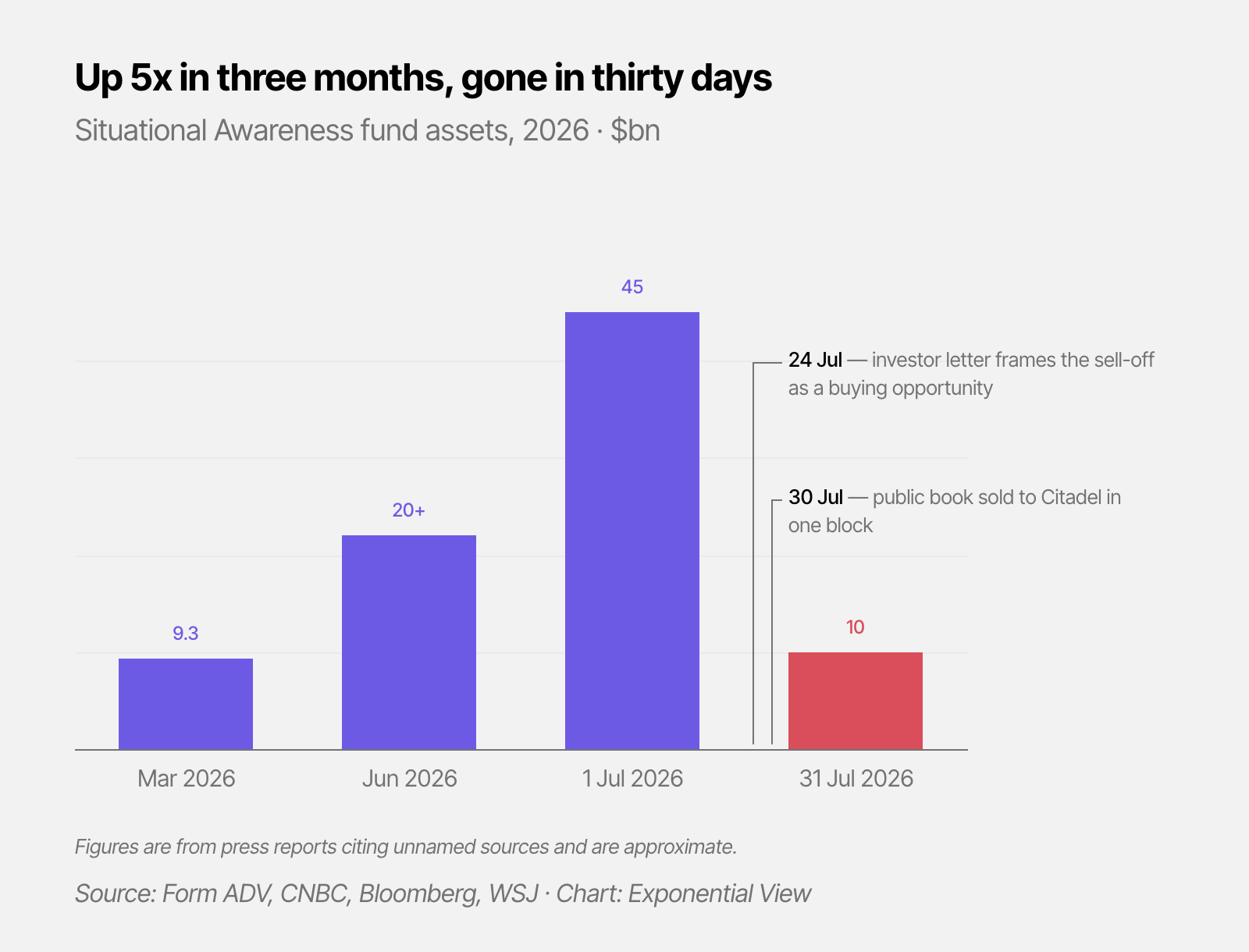
Leopold Aschenbrenner had three of them. His fund, Situational Awareness, collapsed last week under the weight of illiquidity, leverage and concentration. At peak in early July, it managed $45 billion of assets, up fivefold in just three months. But as Cohen says, “it works until it doesn’t.”
In the space of a month, the 29 US-listed long positions in Aschenbrenner’s portfolio fell by an average of 21%, while short positions such as Adobe rose by 26%. Combined with leverage of three to four times, that spelt disaster. The fund was down 67% for the month; strip out private company holdings such as Anthropic, which made up around $10 billion of the $45 billion peak assets, and the public portfolio was down around 85%.1
We’ve talked about margin calls here before. Aschenbrenner tried to avert his on July 24 in a letter that invited investors to inject fresh capital. “At times, we call out opportunities that seem like a particularly good time to add funds, if you have been waiting for one,” wrote Aschenbrenner. But by then, his problems were well-telegraphed and the market took over:
“As these moves proceeded, we started to see increasingly adverse trading in names publicly associated with us. These dynamics are essentially similar to a bank run: vulnerability begetting more vulnerability. We worked to keep the portfolio within our risk parameters, but gradually this became more difficult as positions rapidly moved against us and market liquidity dried up.”
It’s a story all too familiar. Faced with increasingly punitive margin calls, Aschenbrenner was forced to liquidate most of his public portfolio via a single block trade at a 10% discount to market value. The transaction, with Citadel, removed all leverage from the fund, allowing Aschenbrenner to enjoy his wedding without his phone vibrating and return to a business bruised but still standing.
“We are continuing to operate as a hybrid public-private fund as before. However, we will manage our public book on a fully-paid-for basis while we draw the lessons from these developments. Most importantly: we took the steps that were necessary to fight another day.”
Aschenbrenner may very well come back stronger. John Arnold – along with Steve Cohen, one of the best traders of his generation – reflected that his philosophy when hiring traders used to be that the “optimal number of past blow ups was one.” The record bears this out. Several of the top hedge fund managers of all time have survived single periods of catastrophic loss: Ken Griffin of Citadel and Chris Hohn of TCI were down 55% and 43% respectively in 2008.
No wonder failed managers find it easy to raise fresh capital. After the demise of LTCM in 1998, principal John Meriwether raised a new fund, JWM Partners, whose assets rose to $2.7 billion. And, 25 years on, Ryan Jacob is still running the Internet Fund he grew from $200,000 in 1999 to $600 million at peak before seeing it fall by two thirds in the early 2000s.
Perhaps the best precedent for Situational Awareness, though, is Amaranth Advisors, which, at the time of its unwind 20 years ago, was the largest hedge fund collapse in history. Its “star” trader Brian Hunter raised commitments of $800 million from 25 investors after he blew up his former fund. His new fund, Solengo Capital, never got off the ground for … reasons, but the tale provides further evidence of Arnold’s point.
Indeed, if he’s looking to “not waste the opportunity to learn from these events,” Aschenbrenner could do worse than to read up on Amaranth.
Like his own fund, it was bailed out by Citadel after being shopped to multiple buyers. Its star trader was just two years into the job and was feted by the media. The Wall Street Journal dispatched a reporter to Hunter’s home in Calgary a month before his downfall to write a feature on the “hotshot trader everyone was talking up” – just as it had on Aschenbrenner in June (“The 24-Year-Old AI Wiz Who Counts Jane Street as an Investor.”) Both survived a prior wobble; both were rejected by Blackstone; both finally came undone during the summer – and both neglected Cohen’s sage advice against layering concentration on leverage on illiquidity.2
For Aschenbrenner it’s too late, but for others looking for a historical lesson in risk management – and how it can be applied today – read on.