
Financing the AI Boom 3
Nvidia, Guarantor of Last Resort
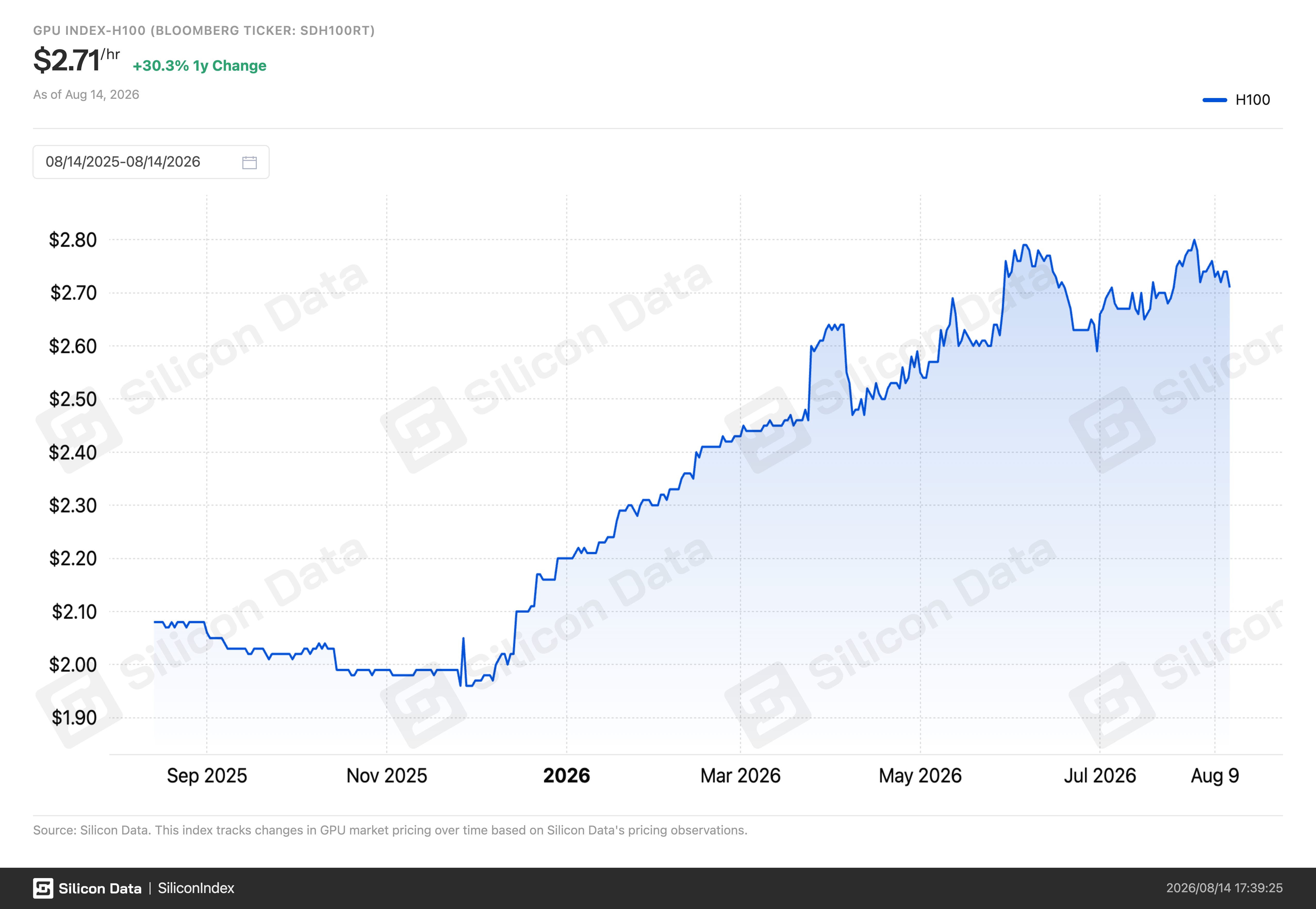
Last November, in Bubble Trouble 2, we looked at AI chips as the font of a new asset class. At the time, their prices weren’t going up, hence the cautionary title. But nine months is a long time in AI and as demand for compute has accelerated, legacy GPU prices have inflected.
“Everyone in 2024 and 2025, even if you were really bullish, you thought that GPU prices would decline slowly,” said tech investor Gavin Baker on a recent podcast. “If you were bearish, you thought they would decline precipitously. I don’t think anyone in ‘24 or ‘25 thought that the prices of old GPUs would be going vertical.”
Yet they are. According to Silicon Data, the price to rent a Nvidia Hopper H100 chip for an hour has risen to $2.71, up from $1.96 at the end of November. And there’s no sign of a slowdown. Forward rates compiled by Silicon Data (more on them later) curve upwards into 2027 and 2028. One rental customer, Baseten, a provider of software and computing capacity to companies tapping into lower-cost AI models, revealed recently that its cloud service provider will push up the rental price on its Nvidia Blackwell B200 GPUs from $2.63 per hour to $5.10 when its contract renews in October.
Even older vintage chips are appreciating. CoreWeave, which rents out GPU infrastructure to AI developers and enterprises, said on its earnings call this week that it has signed a contract to lease Nvidia Ampere A100 chips – a product introduced in 2020 – all the way out to 2029 at “an attractive price”. Despite their age, “we remain largely sold out of prior generations of NVIDIA GPUs in addition to the current SKUs,” added the firm’s CFO.
Nvidia CEO Jensen Huang reflected:
“The mighty A100 fleet are mission-capable from 2020 through 2029. NVIDIA computing is more than chips. CUDA gives developers and NVIDIA engineers a common platform to continually upgrade Ampere, Hopper and Blackwell throughout their useful lives. CUDA makes NVIDIA computing versatile. Versatility makes it fungible. Fungibility drives utilization and extends durability, making NVIDIA compute a productive asset: rentable, durable and financeable.”
Huang’s comments come off the back of a deal with Apollo, BlackRock, Blackstone, Brookfield, Goldman Sachs and KKR to mobilize over $500 billion of third-party capital to support the buildout of AI infrastructure. The deal was made possible by the resilience of GPU pricing. If Huang is right that his chips are durable, then the scope to finance them widens.
“People are going to begin to recognize that this is a financeable asset class,” said Blackstone president, Jon Gray at the launch. “When you go to buy a house, the bank underwrites you but they also look at the value of your home. When an airline goes to buy a plane, they look at the credit of that company but also the plane. I think historically here, the limitation has been investors have said, I only want so much exposure to this hyperscaler or maybe to this foundational model company. I think when people recognize how powerful and valuable this compute is, no matter who’s using it…markets are going to recognise the opportunity.”
His peers lined up in agreement. Larry Fink, CEO of BlackRock went so far as to say, “This is the very beginning, like what it was when I started in the mortgage-backed securities market in the 1970s and I look upon this as a next future for financial engineering.”
To see how this new asset class is shaping up and whether it can reach the size of the mortgage-backed securities market or other established markets, read on.