
Two Tribes
Private Credit, Public Markets and the AI Reckoning
A reminder that paid subscribers get exclusive access to my podcast, Net Interest Extra. Last week, I interviewed two of my favorite bank analysts, John McDonald and Brian Foran of Truist Securities. We talked about regulation and consolidation and credit and all the other big themes in the sector. Next week, I’m looking forward to talking to Sarah Quinn, author of the terrific book American Bonds which reshaped the way I look at credit provision in the US. If you’re not already signed up to the full Net Interest package, you can do so here.
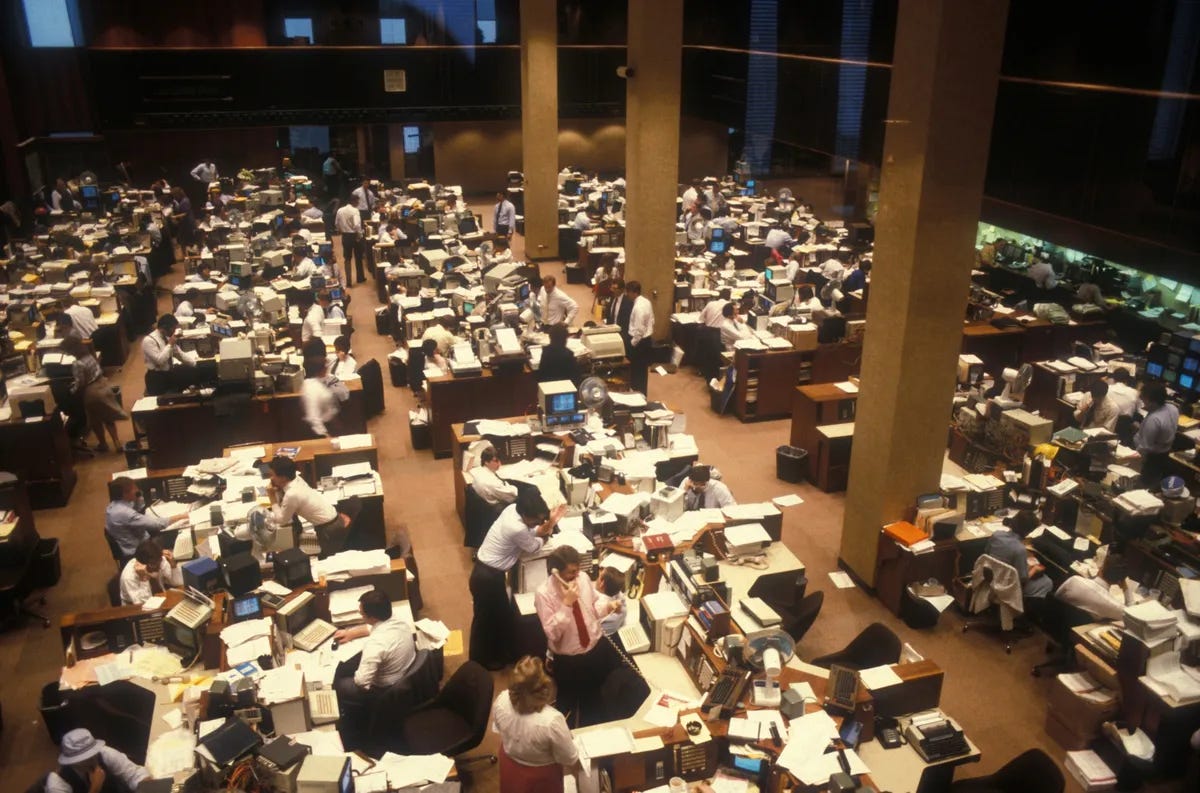
When I joined Credit Suisse First Boston in London in the early 2000s, the firm had already been in its gleaming new Canary Wharf office for almost a decade. Most of my first few weeks were spent getting to know my way around the equities floor – meeting colleagues, learning the rhythms of the place. It was only when I ventured onto the fixed income floor that I realised something was off. It was bigger. Noticeably so. At the time, this seemed odd. Equity markets were ascendant, the focus of the firm’s attention. In the few years before I joined, equities had consistently dwarfed fixed income in revenue.
The explanation lay in the building’s history. When CSFB moved in during 1991, bonds were where the money was and the floor plan reflected that. It was the same across Wall Street. Michael Lewis recalls that at Salomon Brothers, “the equity department wasn’t on 41, the principal trading floor, but on the floor below. The fortieth floor had low ceilings, no windows, and the charm of an engine room.” Inside Salomon Brothers, he writes, “the men from equities were second-class citizens.”1
By the time I arrived, status had inverted. The great bond massacre of 1994 wiped an estimated $1.5 trillion off global bond markets – equivalent to almost 10% of OECD countries’ gross domestic product. Meanwhile, equity markets boomed as retail participation grew and a new economy formed. The tenants of the 41st floor at Salomon (and the third at CSFB) had their reckoning.
But tensions persisted across what remained a gaping cultural divide. Bond traders saw themselves as more serious than their lower-floor colleagues. They prided themselves on a less emotional outlook, one grounded in numbers rather than narrative. Their bias was to avoid losing principal while equity traders went in search of upside.
Bill Gross embodied the disposition. Even in his firm’s early days, when he shared a floor with the stocks guys and was yet to become the “Bond King,” the disdain was barely concealed. As his biographer Mary Childs recounts, he could “hardly help himself, looking down his nose at their foolhardiness, their brash optimism. He couldn’t help it; it always came out.”
For an equities guy, I’ve always had sympathy for the bond view of the world. Probably because as a banks analyst, I covered the sector where the two markets intersect. One way of looking at a bank is as a transformation engine for turning debt into equity. Its balance sheet embeds a portfolio of fixed income instruments – loans and bonds – which it funds partly through issuing equity to shareholders. The trope of a bank as a hedge fund isn’t far from the truth.
To understand banks, then, it pays to make the occasional trip to the fixed income floor. So when Matthew Mish, head of credit strategy at UBS, projects that in a tail scenario of rapid, severe AI disruption, high yield defaults could rise to 3-6%, leveraged loan defaults to 8-10% and private credit defaults to 14-15%, it’s worth investigating. For reference, we’re currently at 0.9% in high yield, 1.6% in leveraged loans and 4.5% in private credit, so these estimates reflect quite a shock. They take levered loan defaults back to financial crisis levels, and private credit defaults beyond anything we’ve seen before. “Contagion risk to public credit markets is real and underappreciated,” he goes on. And “this raises concerns about capital adequacy and loss absorption [at financial institutions] in a downturn, particularly if defaults spike and valuations collapse.”
These days, it’s not just banks that are exposed. Credit is disbursed through private credit funds, business development companies and other vehicles, and the equity of some of them has already begun to rupture. Boaz Weinstein, a former resident of Deutsche Bank’s bond trading floor, now founder of Saba Capital Management, a credit-focused hedge fund, reckons “there’s a nasty storm brewing and public credit is oblivious so far.”
We discussed business development companies here last year. The sector has moved on since then – not in a good way. What follows is a closer look at where the cracks are appearing, and what they might portend. To join me on the bigger trading floor, read on.