
The Future of IR
What the Changing Shape of Markets Means for Investor Relations
Among the hundreds of job vacancies SpaceX is looking to fill, from aerodynamics engineer to welding inspector, one stands out. Ahead of its stock market listing, the company is advertising for an investor relations manager to assist in the day-to-day running of its IR activities. Candidates should have at least six years experience in finance, investment banking or asset management, an MBA and/or CFA qualification, strong financial acumen and communications skills. Oh, and they should have a deep understanding of social media dynamics.
Social media remains a relatively new frontier in investor relations. Barclays is also looking to hire an IR manager and its job spec makes no mention of social media. The successful candidate there is expected to prepare and review presentations, cultivate shareholder relationships and manage events “to effectively communicate the company’s story to investors.”
Payments company Fiserv is another firm looking to hire. Tasks include collecting investor feedback, gathering information on competitors’ earnings, managing the quarterly earnings reporting process, maintaining a record of publicly disclosed information, and representing the company on investor calls. Unlike their counterpart at SpaceX, Fiserv’s investor relations officer won’t be required to “monitor social platforms, retail investor forums, and market commentary to track sentiment, engagement trends, and emerging narratives.” Scrolling is not part of the day job at Fiserv.
Of course, SpaceX is a different kind of company. For a start, it owns its own social media platform, X, where many of its prospective shareholders congregate. CEO Elon Musk already showcased his disdain for traditional investor relations processes back in 2018 when he cut analysts off his Tesla earnings call for asking boring, bonehead questions. “These questions are so dry. They’re killing me,” he said. Instead, he went to YouTube and invited questions from Gali, a 25-year-old fanboy who couldn’t believe his luck (“I’m still basically in complete shock right now,” he told viewers afterwards).
These days, Tesla uses Robinhood-owned Say Technologies to canvass questions from individual investors. On its most recent call, 4,900 participants submitted 86 questions through the platform; nine were answered. That left time for only five Wall Street analysts to ask questions.
When I was a regular attendee on earnings calls, they were heavily choreographed affairs. No investor relations manager wanted to run the risk of inviting Buddy Fox from Geneva Roth Holding Corporation onto their call, or Bruce Wayne from Wayne Enterprises. But the rise of retail participation has changed the landscape. The share of US households that own stocks has surged this decade to nearly 60%. Broadridge, a company that offers investor communications services, helps administer around 1.5 billion shareholder positions, up 15% on last year. For the first time, Americans hold more wealth in stocks than in their homes. Retail trading activity now accounts for roughly 20% of total US equity trading volumes.
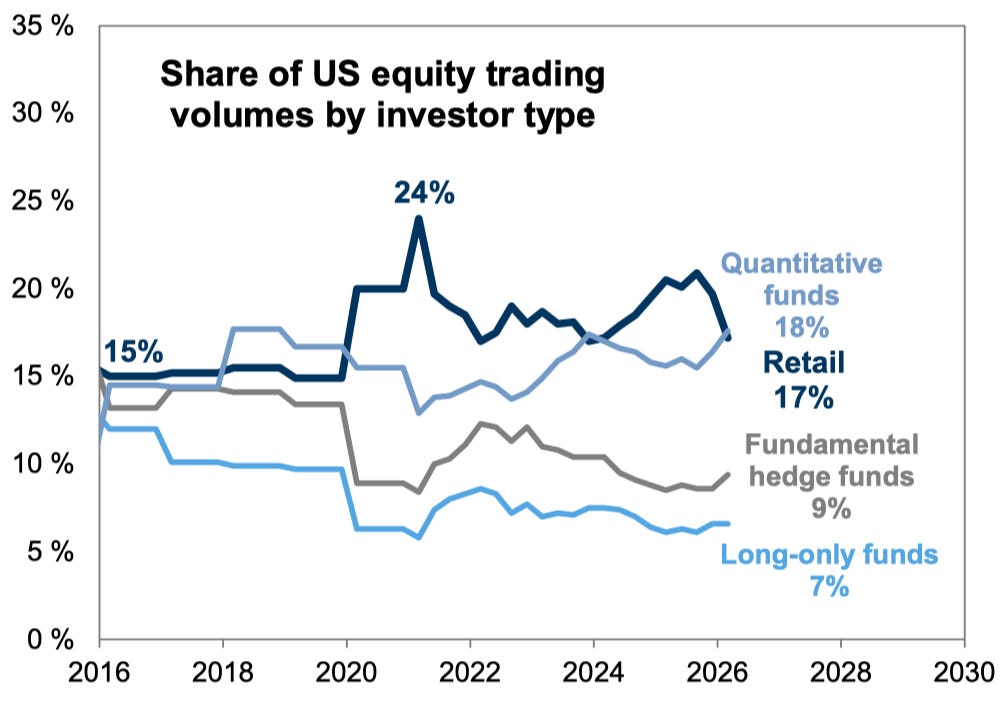
The shift comes at the same time as passive becomes more dominant. We talked last week about the demand for SpaceX shares from index funds – a group that the company’s new investor relations manager won’t have to court. Invesco’s exchange-traded fund QQQ alone will be obliged to buy an estimated $2.7 billion of stock whether the role is filled or not. With such a large share of the market impervious to their charms, investor relations officers can focus their attention elsewhere – on retail investors and, increasingly, on audiences inside the company. To understand where the role is headed – and how it got there – read on.