
It’s Scott Bessent’s birthday today. He’s sixty four. Rather than doing the garden, though, digging the weeds, the US Treasury Secretary has been intervening in bond markets. In an effort to stem rising yields, Bessent announced that his department would ramp up purchases of longer-dated government securities. “We shall scrimp and save,” sang McCartney. Not so, Bessent.
As Treasury Secretary, Bessent sees himself as “the nation’s top bond salesman”. It’s a big job. In fiscal year 2025, his department issued a total of $30.2 trillion in marketable securities to investors in over 400 auctions. “The Treasury market remains the deepest and most liquid market in the world,” he touted in November, “a testament to the efficacy of the Trump Administration’s economic policies.”
But by Bessent’s own yardstick, his performance has been slipping. “Treasury yields are a strong barometer for measuring success,” he said of his role. In the most recent auctions he has conducted, yields have lurched higher. A $42 billion auction of the 10-year Treasury note on August 12 pushed the auction yield to 4.683%, the highest level since 2007. The following day, a $25 billion sale of the 30-year Treasury bond resulted in an auction yield of 5.216%, the highest level since 2001. Investors showed up, submitting bids worth around 2.5 times the debt on offer, but they demanded a higher return to do so.
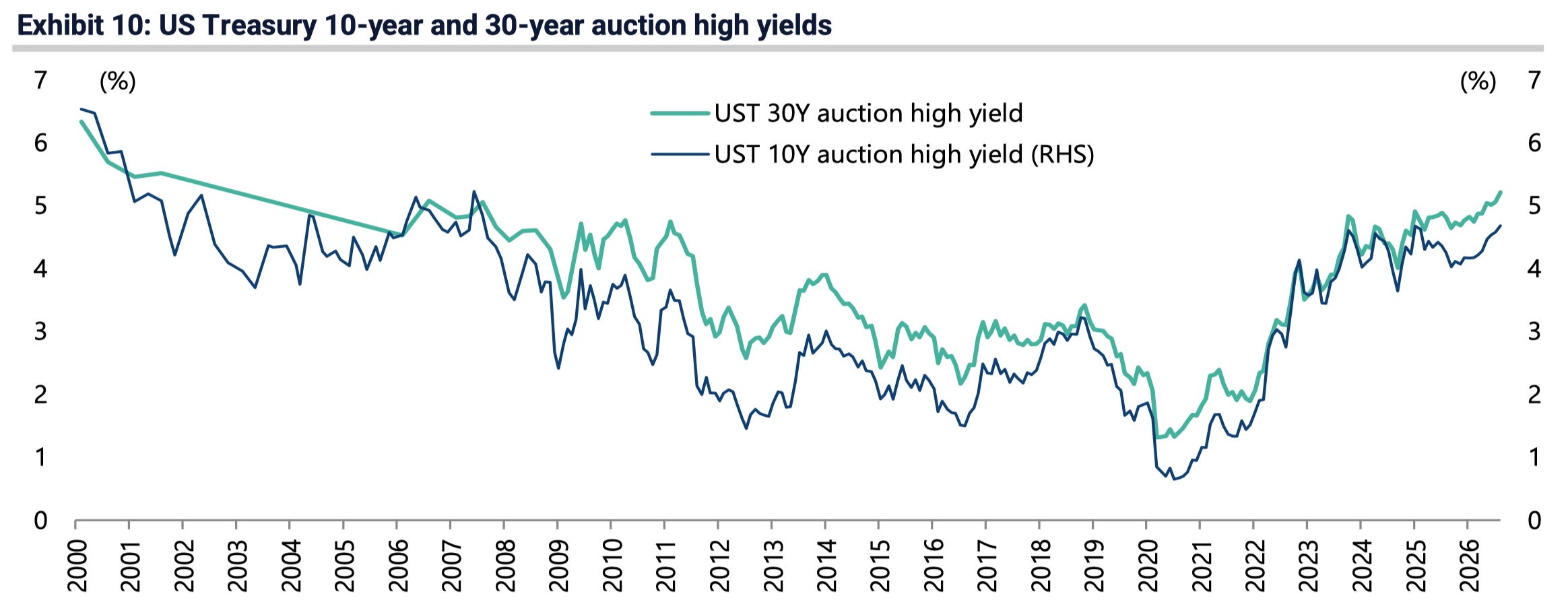
With outstanding debt of over $40 trillion, interest costs are mounting. At over $1.2 trillion on an annualised basis, the cost of interest on government debt now exceeds what the US spends on national defense – the first sustained occurrence of this in the post World War II era. Combined with entitlements, annualised net interest rose to 98.4% of government receipts in the 12 months to July, up from 96.2% in 12 months to June, and the highest level since the record 99.7% in the 12 months to June 2020 when the Fed was engaged in Covid-triggered monetisation.
Seasoned risk managers are worried.
Stan Druckenmiller: “The fiscal recklessness of the last decade has been like watching a horror movie unfold.”
Ray Dalio: “Debt service is like plaque building up in the arteries… When you get to the point where we are, which is very close, that you have to borrow money to pay the debt, then that is the problem.”
Ken Griffin: “If your fiscal house is not in order, the bond vigilantes can come out and extract their price.”
Jamie Dimon: “The way it’s going now, there will be some kind of bond crisis, and then we’ll have to deal with it. And it will be okay, it’s just not the way to do it.”
David Solomon: “If we continue on the current course, and we don’t take the growth level up, there will be a reckoning on this.”
Jeff Gundlach: “The long-term Treasury bond is not a legitimate flight-to-quality asset. It’s not responding to lower interest rates… The reckoning is coming.”
Even everyday risk managers are concerned. In a recent survey of bond investors, registered voters and economics or finance graduates, respondents put the odds of a crisis within ten years at close to 50%. Among investors, simply being shown the current debt level and the Congressional Budget Office’s long-run projections raised their stated ten-year crisis probability by 14.9 percentage points.
While a full-blown crisis may be some way off, casualties of higher rates are mounting. Back in 2023, the banking sector was first to experience the aftershock of rising rates when Silicon Valley Bank collapsed. This month, United Wholesale Mortgage, the nation’s largest mortgage lender, was forced into a bailout as it, too, floundered on persistently higher long-term rates.
To explore whether this is the start of a reckoning, and why Bessent felt compelled to intervene in markets, read on.